

 United Kingdom
 Canada
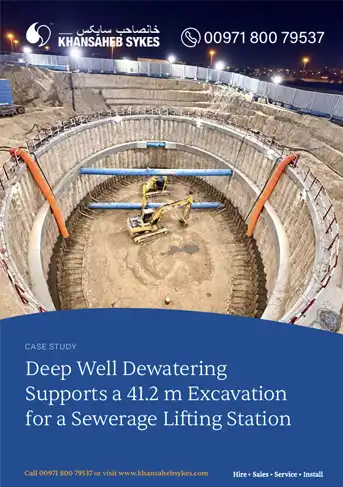
A secant pile wall supports a deep excavation, but it does not remove the groundwater on either side of it. At Al Qusais, Dubai, Khansaheb Sykes is providing deep well dewatering for a new sewerage lifting station that will connect new developments to the city’s sewerage system. The excavation goes down to 41.2 metres below existing ground level, through layered sand and fractured sandstone.
As of November 2026, our system of 15 deep wells has kept the working platform dry. The project is ongoing.

Why Does a Secant Pile Wall Still Need Dewatering?
A secant pile wall retains soil. It does nothing to reduce the groundwater pressure acting on it.
Groundwater pressure increases with the depth of water. On a deep excavation, that is a load the wall has to resist.
On this project, the wells work on both sides of the wall:
- Inside (7 wells): lower groundwater inside the wall.
- Outside (8 wells): lower groundwater outside the wall.
The aim is to reduce water pressure on the wall and mitigate any seepage.

What Did the Ground Demand of the Design?
Fractured rock carries water more readily than the intact rock around it. In interbedded ground, the fractured bands tend to carry most of the flow, so the design has to allow for the most permeable zones, not the average. The planned excavation level is -30.70 DMD, against an existing ground level of +10.5 DMD: a depth of 41.2 metres.
The ground here, from the surface down:
- Permeable sand
- Moderately permeable sandstone
- Very weak, weathered, fractured layers interbedded within the sandstone
Those fractured layers were treated as highly permeable and as a source of groundwater. The deep well system was designed to manage them.
Ground conditions drive the design. For tidal sand with no shoring, see Case Study: Large-Scale Dewatering: Fronds & Spine, Jebel Ali, Dubai. For another deep excavation in Dubai, see Case Study: Managing Fines Migration in Deep Excavation Dewatering.
How a Deep Well System Lowers Groundwater
Each deep well is a bored hole with a submersible pump inside. The system works in four steps:
- The pump draws the water level down in the well.
- Groundwater flows towards the well, so the water table around it falls.
- Drawdown from neighbouring wells overlaps, lowering the water table across the excavation.
- A discharge system carries the pumped water away.

Key Equipment

Submersible Borehole Pumps
15 multistage electric submersible pumps, rated up to 5.5 kW, installed in the deep wells.
Why Does Standby Capacity Matter?
A deep well system holds groundwater down only while the pumps run and power is available. If pumping stops, groundwater starts to recover and the excavation is at risk.
On this site:
- Standby pumps are held on site.
- Standby generator capacity is also on site. The generators are supplied by the contractor.

What Has the System Delivered So Far?
- The project is ongoing and runs from June 2026 to May 2027.
- A dry working platform has been maintained throughout the excavation to date.
- No site issues have been reported.
- The system has run as originally designed, with no adjustments needed since start-up.
In short, the 41.2-metre depth, the fractured ground and the need to dewater both sides of the wall set the brief. The deep well system has held the working platform dry to date. This project reflects Khansaheb Sykes’ specialist capability in infrastructure dewatering.
Download Case Study
 | Download Case Study: Deep Well Dewatering Supports a 41.2 m Excavation for a Sewerage Lifting Station |
|---|

Need Expert Support for Deep Excavation Dewatering?
| Khansaheb Sykes delivers reliable dewatering expertise across complex construction environments. Speak to our team today on 00971 800 79537 to discuss your project requirements or enquire now. |
|---|
FAQs
What is deep well dewatering?
Deep well dewatering lowers groundwater using bored wells fitted with submersible pumps. It suits deeper excavations, or sites where wellpoint dewatering is deemed inefficient.
Why use submersible pumps in deep wells?
A surface pump relies on suction, which limits how deep it can draw water. A submersible pump sits in the well and pushes water up, so it works at depth.
What decides how many deep wells an excavation needs?
It depends on the permeability of the ground, the excavation depth, the drawdown required and the area to be dewatered. Fractured or highly permeable layers usually need more wells, or wells placed closer together.


